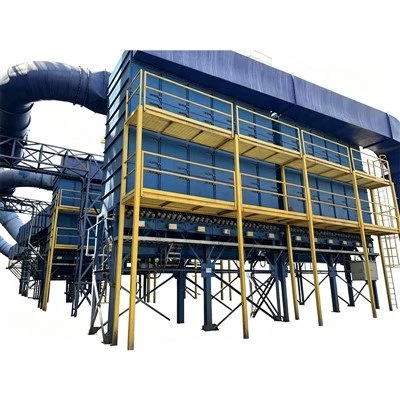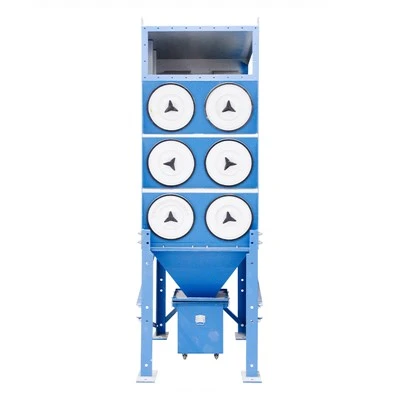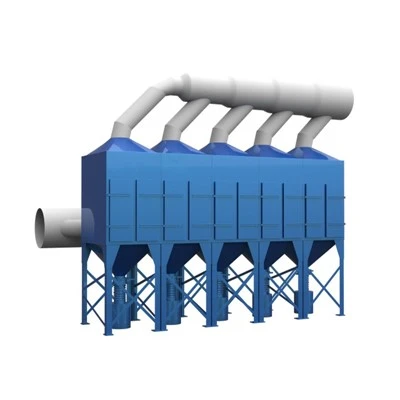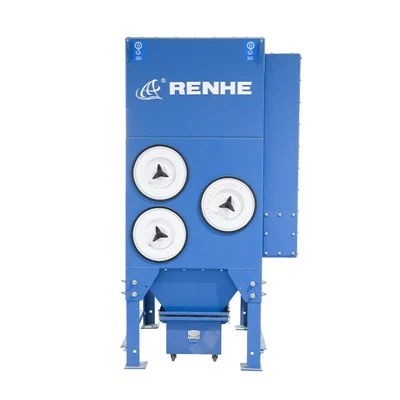
There is no single, universal operating principle for industrial dust collectors; principles vary significantly across different equipment types. They can be categorized into the following typical groups based on their core characteristics:
Core Operating Characteristics of Mainstream Types
Mechanical Type (e.g., Cyclone Dust Collectors)
Separation Mechanism: Relies entirely on centrifugal force (generated by airflow rotation) and gravity to separate dust from gas; requires no external power or chemical additives.
Structural Features: No internal moving parts; compact design (volume is only one-third that of comparable equipment); temperature resistance up to 400°C.
Applications: Suitable for large dust particles (5–100 μm); ideal for high-temperature, high-dust-concentration pre-separation scenarios.
Filtration Type (e.g., Baghouse Dust Collectors)
Filtration Mechanism:Captures dust through sieving, inertial impaction, and diffusion via filter bags; the initial dust layer formed on the bag serves as the primary filtration layer.
Cleaning Characteristics: Equipped with pulse-jet cleaning systems that periodically dislodge accumulated dust from the bag surface to maintain stable filtration resistance.
Performance: Removal efficiency exceeds 99% for particles larger than 0.1 μm; resistance remains stable between 980 and 1470 Pa.
Electrostatic Type
Workflow: Ionizes gas via a high-voltage electric field; dust particles become charged and migrate toward collection plates under the influence of electrostatic forces.
Core Advantages: Capable of removing sub-micron fine dust; purification rates exceed 99%; lower overall energy consumption.
Applications: Commonly used in industries with high flue gas volumes, such as metallurgy and coal-fired power plants.
Wet Type
Capture Logic: Uses liquid droplets or water films to contact dust-laden gas; captures dust through impaction and agglomeration, subsequently discharging it with the water flow.
Specific Features: Venturi types can handle ultrafine dust (0.05 μm); spray types are resistant to clogging and suitable for high-concentration dust-laden flue gas.