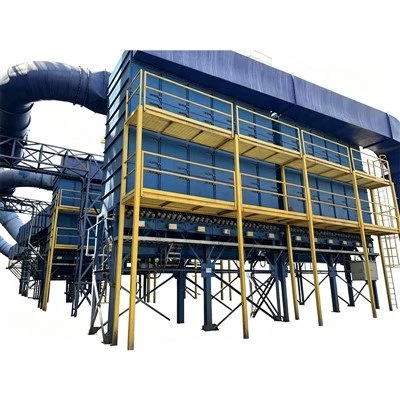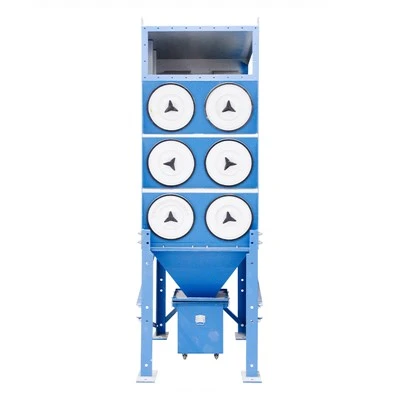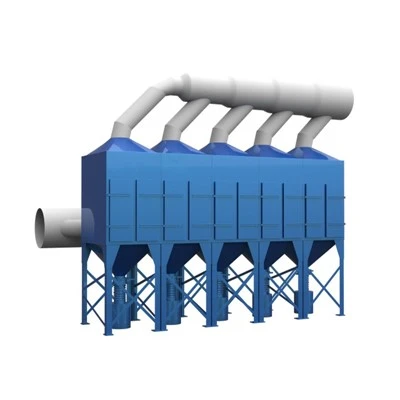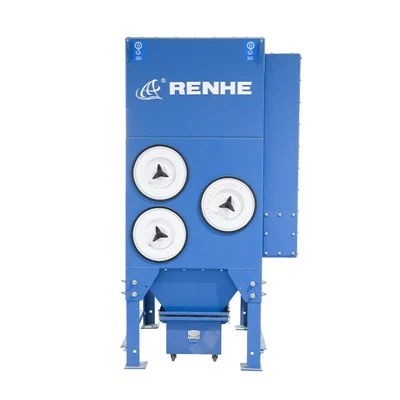
Core Operating Principles of Four Mainstream Types
Bag-type (Fabric Filter) Dust Collector
Core Logic: Dust-laden gas passes through filter bags; dust is trapped on the bag surface, while clean air permeates the fabric and is discharged.
Supporting Mechanism:Once dust accumulates to a certain level on the bag surface, a pulse-jet cleaning system dislodges the dust, causing it to fall into the collection hopper at the bottom.
Cyclone Dust Collector
Core Logic:Dust-laden gas enters the cylindrical body tangentially at high speed, creating a vortex. Centrifugal force throws dust particles against the vessel walls, causing them to slide down into the hopper, while the purified gas rises through the center and exits.
Additional Characteristics: Centrifugal force acting on 10μm particles can reach 500–2,500 times the force of gravity; removal efficiency for non-sticky, dry dust larger than 10μm can exceed 90%.
Electrostatic Precipitator (ESP)
Core Logic: A high-voltage electric field ionizes the gas; dust particles become electrically charged and migrate toward collection plates under the influence of the electric field, where they deposit, while the purified gas is discharged.
Additional Characteristics: Dust removal efficiency can exceed 99%; low airflow resistance makes it suitable for handling high-volume, high-temperature flue gas.
Wet Dust Collector
Core Logic: Liquid (via water films, sprays, etc.) is brought into full contact with the dust-laden gas; dust is captured by liquid droplets or films and discharged along with the water flow, achieving gas-solid separation.